Ho Chi Minh City and Hanoi—the two largest cities in Vietnam—are accelerating their green transport transition, with a strong focus on urgently developing mechanisms and policies to support individuals and businesses in shifting from fossil fuel–powered vehicles to clean energy alternatives.
Prioritizing Public Transport Transformation
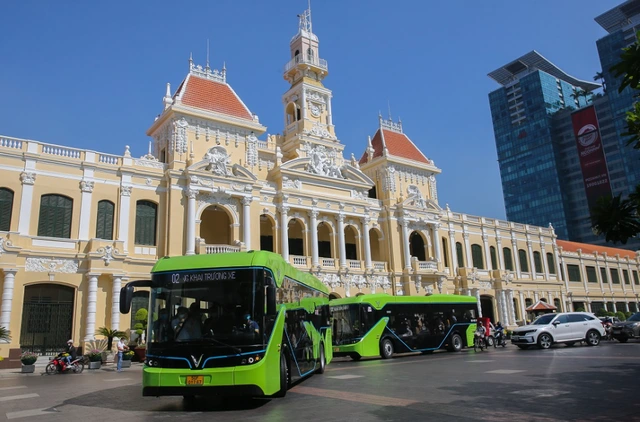
Electric buses in Ho Chi Minh City (Photo: Thanh Niên)
In Ho Chi Minh City, Vice Chairman of the Municipal People’s Committee – Bùi Xuân Cường has recently directed the Department of Transport to urgently update, revise, and finalize the draft Resolution on mechanisms and policies supporting the transition of bus fleets. The Resolution is expected to be submitted to the City People’s Council at its upcoming session, with particular emphasis on financial support policies such as preferential loans and interest rate subsidies for investments in vehicles, electric charging stations, and CNG refueling stations serving public transport.
Earlier, the Ho Chi Minh City People’s Committee also assigned the Department of Transport to lead and coordinate with relevant agencies to comprehensively review existing policies supporting the transition to green vehicles. At the same time, solutions are being proposed to control traffic in areas experiencing high levels of air pollution.
According to the plan, Ho Chi Minh City’s green transport transition will be implemented in two phases. Phase 1, to be carried out in the first quarter of this year, focuses on developing policies to encourage the adoption of electric buses and other green-energy public transport vehicles. By the third quarter, the city aims to complete policies supporting the transition of remaining vehicle categories. In Phase 2, Ho Chi Minh City is considering pilot programs for electric and green-energy transport in Cần Giờ District and several central urban districts.
With the goal of achieving 100% electric buses by 2030 and moving toward fully electrified transport between 2040 and 2050, the city has identified supportive policies for businesses and incentives for residents as critical foundations. Experts note that the biggest barriers at present remain investment costs and the convenience of using electric vehicles. Only when businesses can reduce costs and users benefit from lower expenses and easy access to charging infrastructure can the green transport transition be implemented in a sustainable and effective manner.
Hanoi Takes Decisive Action Amid Pollution Pressure
Air quality in Hanoi on February 4, 2026 (Source: IQAir)
In Hanoi, the green transport transition is also being pursued consistently as air pollution reaches increasingly alarming levels. The city aims to replace approximately 103 diesel buses that have reached the end of their depreciation and contract terms with electric buses within this year, accounting for about 5% of the total bus fleet. By 2035, Hanoi targets converting 100% of its buses to green vehicles.
To achieve this goal, Vice Chairman of the Hanoi People’s Committee Nguyễn Mạnh Quyền stated that the city is directing the Department of Transport to soon submit to the City People’s Council specific mechanisms and policies that support businesses in investing in and transitioning to clean-energy vehicles, alongside the development of synchronized infrastructure and charging stations.
EBOOST Accompanies the Green Transport Journey
Alongside policy efforts by major cities, the role of businesses in developing green energy infrastructure is becoming increasingly important. Among them, EBOOST – a developer of electric vehicle charging station networks in Vietnam – is gradually expanding its footprint, contributing to addressing infrastructure challenges in the transition to electric mobility.

The electric vehicle charging station network is gradually expanding (EBOOST)
With a strategic focus on building a convenient, accessible charging ecosystem compatible with multiple electric vehicle models, EBOOST positions itself as a long-term partner to government authorities, transport operators, and the public in the journey toward green mobility. Investments in synchronized charging infrastructure across residential areas, commercial buildings, industrial zones, and key transport hubs are seen as a fundamental enabler in reducing barriers to electric vehicle adoption, thereby accelerating a faster and more sustainable transport transition.